
Whilst we are starting to identify and build the number of sites for haven accreditation, we thought it would be nice to introduce some of them to you.
Lordington Park
House martins have taken to the gables of Lordington Park (an 1850’s build), north-west of Chichester (West Sussex) big time, many occupied. The birds regularly come and go in the spring and are away in September. This year on 10th May there were 37 nests, most on the south, fewer on the east and west and none on the North gables.
The owners report that other groups of house martins arrive on the building during the autumn migration period and are gone shortly after. This perhaps means that the building is used as a staging post for birds on migration. The feeding grounds of the park are excellent since below the house is a chalk stream (which sometimes dries in the hot summers) – chalk streams are particularly biodiverse in insects. So from a house martin point of view this is a good location to feed up for the long haul south. Perhaps it is not a coincidence for a bird leaving this location that the nearest southerly tip of England is Selsey Bill which is 20km to the south – just a few minutes for the commuting bird. Like Dungeness (Kent) Selsey Bill sticks out into the English Channel and helps to funnel HMs on their way. Perhaps this is evidence that there is a ‘fly-way’ which exists for birds exiting the country in the autumn and welcoming incoming birds in the spring.
Lordington Park is a boutique bed and breakfast hotel in the heart of the South Down National Park and is thoroughly recommended for its avian residents. There is a cafe in the hotel which welcomes cyclists, and dogs are welcome.
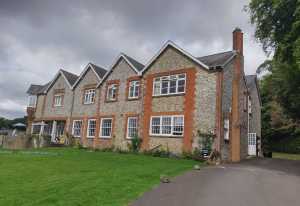
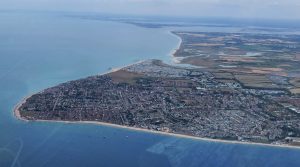
Lordington Park, and Selsey Bill peninsular. Photos by John Feltwell.
Ludgrove School
Ludgrove school in Wokingham, Berkshire, has a very significant local colony with 40+ natural nests.
In March, fellow Committee member Barbara Polonara ran a whole school house martin presentation to highlight the importance of the colony, which was well received by staff and students. This led to the installation approval of 15 artificial nest cups, made at the school by design technology students.
Furthermore, thanks to their efforts, one of the students featured in the power of youth day promoted by Berks, Bucks, & Oxon Wildlife Trust, and one of the teachers has become a house martin champion, and is closely monitoring the nests and colony, and reporting any issues. Barbara will be working with them again next year, making sure the colony is properly monitored during the breeding season.
Ludgrove School has truly engaged with the house martins they host on their building, and assisting them with nest opportunities to increase the population.
Ampleforth Abbey
In the heart of North Yorkshire, Ampleforth Abbey, a working monastery, is settled within the countryside landscape. As well as welcoming people to visit the abbey, it is a welcoming host to a very significant colony of 40+ house martins.
In recent roof renovations every old nest was preserved to protect the colony there. The House Martin Haven certificate issued to them by our charity is displayed at the Abbey, helping to create awareness to the public that venture there. Jonathan Pomroy, our resident artist, and former committee member will be leading events there including a talk on house martins and other species on the Ampleforth Abbey estate next spring.
If you know of a public building, business building, or residential street that has multiple nests where house martins are welcomed each year, and where the birds and their nests are protected and respected during the breeding season and whilst the birds are overwintering in Africa, you can nominate them via our website here.
View other haven sites here.