

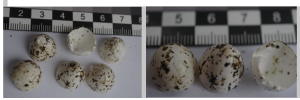
The books generally say that house martins lay ‘four to five glossy white eggs’ though Henry Seebohm (1896)[1] says four to six.
At the end of the 19th century there was a lot of egg collecting and specification of eggs abounds in the books of that period. Seebohm says of the house martin egg that they “vary in length from 0.55 to 0.52mm and very closely resemble those of the sand martin, but are a trifle larger, somewhat coarser grained, and more polished.” Here is section from one of his Plates:
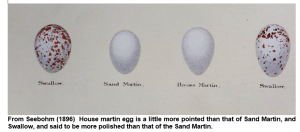
From Seebohm (1896) the house martin egg is a little more pointed than that of sand martin, and swallow, and said to be more polished than that of the sand martin.
Going by the remains of the eggs dropped outside the nest in England and France (dropped up to 15m away), they are neither glossy nor white. They are usually splattered with small black and brown marks as shown above. The reason is likely to be wet debris from the feet and bills of the adults (after all they deal with liquid mud) mixed with droppings of juveniles. With the scrabble of five or six pairs of feet and faeces around the clutch of young birds inside the nest, it is not surprising that the eggs remain intact and spattered. The small size of the splatter marks on the shells suggests that the debris is in liquid form rather than sticky mud-like material. But certainly they would appear to be laid as white eggs, perhaps not glossy.
The thickness of the shell was measured using a Hardell digital calliper, and results on shells from France (30) and West Sussex, showed regular conformity to about 0.1mm thickness. By comparison chicken egg shells are thin (0.28-0.30mm), medium (0.30-0.36mm) or thick (0.39mm). So house martin eggs are considerably thinner and presumably more delicate than chicken eggs. Generally, the more an egg has to hold the thicker the shell. For house martins the eggs are relatively small (just over 1cm across) so the contents are small, and would be less thick than a ‘thin’ chickens’ egg.
It is known that environmental conditions affect shell thickness. Drought effects appear to increase the chances of thicker egg shells (for bluebirds in N. America) which may be a way of reducing water loss from eggs; this occurs faster at higher temperatures according to Romero et al., 2024.[2]
Although the house martin eggs that I examined were all measured along the widest part of the egg, where it might have fractured in any case, conforming with approved methodology, I understand that to get any more accurate measurement of shell thickness would involve electron microscopy which I do not have access to any more. Also, without any default ‘knowns’ of how thick house martin shells should be, I cannot ascertain whether the shells are getting thinner or staying the same as before.
Thus, the question as to whether egg shell case thinning is in any way a contribution to their decline remains unresolved. As insectivores, house martins must eat a variety of insects that have been sprayed with insecticides and other chemicals and the likelihood of these chemicals making their way into the food chain and metabolism of the birds and thus into the eggshell, is high.
I am grateful for BTO (Mark Wilson) for putting me in touch with Prof Tim Birkhead [3] for his advice, both of whom did not know of any research on house martin shell thickness. Thus the well-documented decrease of shell thickness in apex bird predators through PCB accumulation in the 1970 lives on – leading to brittle eggs of predators that fatally cracked in the nest.
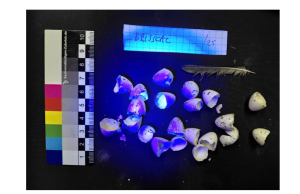
Under Infrared light, the house martin eggshell glow an iridescent purple colour, just the outsides, as seen in the above photograph. The inside of the egg case does not glow, it remains white. One wonders what is the ecological significance of the egg glowing purple on the outside, considering only the nesting birds have sight of the eggs within the mud nest. Perhaps the glowing egg cases discarded outside the nest are either to lessen any attention by predators to the position of the nests?
Although these different colours appear under infrared, it is not known how these would appear under ultra-violet which they can see.
In their traditional nesting locations on cliffs, the eggshells would have fallen away down the cliff and away from the nest locality. In today’s world, along a village high street, the row of house martin nests are littered with eggshells immediately below the nests in the gutter, and that, after rain, there is a sleugh of egg cases making their way towards the nearest drain (ideal for collecting them before they disappear). I am speaking of experience of investigating house martins in a small village in southern France that still has rows of house martins and nests along the ‘centre ville.’
The move by house martins from breeding on cliffs to houses must have been quick. In places like Ballycastle on the Northern Ireland Antrim coast, house martins are breeding on the buildings of this seaside town, with an outlook directly to some large vertical sea cliffs not far away – possibly earlier nesting sites, but subject to unprotected strong winds from the north including gales. Human habitations offer nice overhangs as nest sites and some respite from wind and rain, so the move was an obvious one.
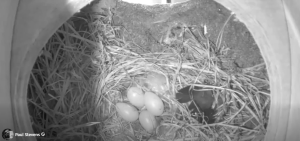
Photo from Paul Stevens showing eggs inside an artificial nest cup via a nest camera.
As for fossils, adult house martins have been identified from the late Miocene period, specifically the species Delichon polgardiensis. However, detailed information about their fossil record is limited. According to Wikipedia Delichon polgardiensis is an extinct species of Delichon that inhabited Hungary during the Neogene period.
ENDS
[1] Seebohm, H., 1896. Coloured Figures of the Eggs of British Birds. Sheffield, Pawson and Brailsford.
[2] Alicia T. Romero, Jadzia M. Rodriguez, Elisa J. Abeyta, Jeanne M. Fair, and Andrew W. Bartlow “The effects of environmental conditions on eggshell thickness of two North American secondary cavity-nesting birds,” The Wilson Journal of Ornithology 135(3), 366-377, (31 January 2024). https://doi.org/10.1676/22-00111
[3] Author of ‘The Most Perfect Thing’ (about bird eggs).